
One year after its latest model refresh, PREDiCT continues to deliver measurable improvements in reserving accuracy for large loss claims.
PREDiCT is our predictive analytics tool for large loss claims and was released to the market in July 2021. Predictions are based on a large and extensive dataset, collated over many years from a wide variety of settled claims involving a broad spread of injury types, insurer clients and lines of business. In May last year, we refreshed the PREDiCT model to include a large number of additional cases specifically intended to expand and refine our dataset. In addition, we enhanced modelling capability in relation to future losses. To scrutinise the performance of the model since implementing these improvements, we carried out analysis in relation to reserving accuracy.
One year on, the results have been very encouraging. We scrutinised a portfolio of 63 eligible cases which settled between May 2025 and June 2026 and benchmarked initial reserves against the ultimate paid outcome (damages). Across this portfolio of 63 cases, the total initial reserves were £39.67m compared to total paid damages of £33.77m.
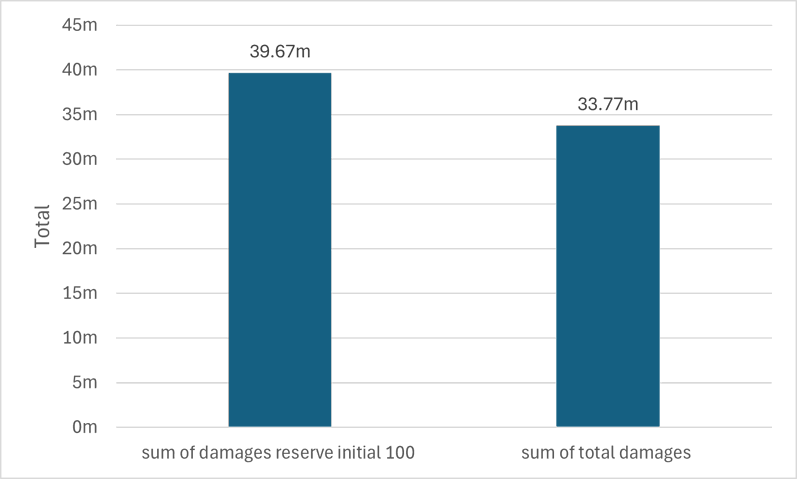
The average initial client approved reserve was £629,693 per case compared to the average paid damages of £536,016, giving an average reserving “variance”, or over-reserve, of £93,677 per case.
We examined the principal injury type for each of the cases in the portfolio, which showed a typical mix of injury types for a large loss portfolio:
Injury type | Case count |
Orthopaedic (all types) | 26 |
TBI | 9 |
Amputation | 3 |
All other injury types | 25 |
TOTAL | 63 |
When we scrutinised overall reserving accuracy for the purposes of our substantive analysis report to the market in April 2025, we were able to demonstrate PREDiCT’s success when measured against its three KPIs. Specifically, prior to PREDiCT being available, the level of over-reserve when compared to paid damages was +138%. We saw the level of over-reserve reduce to +55% compared to paid damages for cases after PREDiCT was launched to the market.
Performance has now improved further - the addition of the new data and enhanced modelling capability has resulted in reduction in the level of over-reserve to +17% compared to paid damages. This has enabled a greater level of excess capital-lock up to be redeployed across our clients’ businesses.
There may be many reasons for this most recent improvement in reserving accuracy performance. PREDiCT has now been fully embedded into our standard case handling. Our handlers and clients have had the benefit of PREDiCT’s data driven insights for five years. There is understandable caution when it comes to reserving. This can be especially true where limited information is known at the outset of a case. However, PREDiCT’s modelling predictions take away the ‘human’ element of caution, and are based solely on data-driven insights extracted from settled claims.
Our figures demonstrating the improved levels of reserving accuracy confirms the benefits of PREDiCT’s data driven insights to support client and handler expertise and experience when setting reserves. This approach will assist reserving accuracy not only at a portfolio level, but also by reducing the extent of reserving “variance” on a case-by-case basis.
Our clients can take renewed confidence that the model is performing very well against its KPI of improving reserving accuracy, and that we continue to scrutinise performance to help achieve excellent results. On the back of the proven success of the model data refresh in May 2025, we plan to update the model again this month. This will further expand the dataset and capture the most recent inflationary and other case trends for the benefit of our clients.
Discover how PREDiCT combines predictive analytics with legal expertise to improve reserving accuracy, support better decision-making and help unlock capital across large loss claims portfolios.
